Thursday, September 29, 2022

Three Things You Can Expect After Integrating Empathy into Your Communication

By Erin Whalen

Empathy is a buzzword these days. It seems to be everywhere from publications such as Forbes and The New York Times to countless LinkedIn articles mentioning empathy’s power and effectiveness.

But in the real world--in the hard work you do helping people die with dignity — is empathy something that fits? And at what cost? What makes it worth the effort? In other words, what’s in it for you?

Empathy does have power; it can help ease your day, as well as those of your patients’ and their loved ones. It’s a shortcut to connection, and if people feel connected to you, they are more likely to listen to your recommendations and trust you as the expert on the death process.

Before we dive into the three things you can expect after integrating empathy into your communication, let’s first define empathy. The research team at Sidney Kimmel Medical College at Thomas Jefferson University in Philadelphia provides the following definition of empathy: “a predominantly cognitive — as opposed to affective or emotional — attribute that involves an understanding — as opposed to feeling — of patients’ concerns, combined with a capacity to communicate this understanding and an intention to help by preventing or alleviating pain and suffering.” Simplified, empathy is the ability to understand another’s perspective and communicate this understanding with the intention of alleviating suffering.

1.
Empathy will save you time.

If empathy requires extra work on your part--recognizing and expressing how others feel--how can it possibly save you time?

For one thing, empathy helps someone feel seen and heard. Have you ever been in a conversation where a person kept bringing up the same point, or returning to the same part of the story and couldn’t seem to move on from it? It’s possible that their behavior was driven by their desire to feel seen or heard. As humans, one of our strongest wants is to be understood. If someone feels understood because you have empathized with them, they won’t harp on the same point. They will relax, knowing that you “get it.” On the other hand, not empathizing can lead to the broken record phenomenon we all want to avoid.

Empathy is also a shortcut to the heart of the matter. When you are working with those who are dying and their loved ones, sometimes empathy can get people to a sense of understanding and peace much sooner by helping to gently reveal the essence of a person’s situation or story. For example, knowing the end is near, a son might be incredibly afraid of watching his mom die. He might show this fear by asking many questions, wringing his hands, and shaking his head as he hears your answers. By gently and compassionately providing some empathy, you can take the edge off his fear and help him work towards next steps. Something like this might do the trick: “Listen, I know this isn’t easy to hear. You love your mom so much. You’re afraid of watching her die, and you might even feel some guilt about being afraid in the first place. I’m here for you, and I am happy to answer any questions you have.” This can help ease his mind a little and he will be more open to continuing the conversation.

2. Empathy will form stronger connections.

When you empathize with another person and really see where they are coming from, your connection will naturally deepen. Connection leads to trust. People who trust their medical providers are more likely to be compliant.

Imagine that your patient’s daughter is in denial about her dad’s need to be on hospice and she also insists he shouldn’t be given pain killers, fearing that he will become addicted. You have the medical knowledge and experience to recognize that her worries are not cause for concern, but you just can't seem to convince her of that.

Empathizing with the daughter by naming her emotions and sharing that you want to alleviate her father’s suffering can help her trust you more. You might try something like this: “You’ve had a lifetime with your dad, and you know him best. You’re worried about his tendency towards addiction, and you’re very hesitant about morphine.” (Pro tip: pausing at this point and allowing her to react is one of the most empathetic things you can do). After hearing more of her perspective, you can proceed with additional empathy and a permission statement: “I can see how much you love your dad and want what’s best for him. In my professional opinion, morphine will actually help not harm him at this point. Would you like to hear more about my thinking?”

Empathy creates the opportunity for a dialogue to occur and for common ground to be found. You both want what’s best for the patient, her father, but it may take a bit of empathetic conversation to get there. Once you do, however, it will not be time wasted. When she trusts you, she will be more willing to listen to your expertise and follow the plan.

3. Empathy can help your days be filled with less stress and more fulfillment.

Dr. Dan Siegel, a clinical professor of psychiatry at UCLA’s School of Medicine, uses a hand model of the brain to talk about emotional regulation. When we are in a heightened emotional state, our prefrontal cortex, where rational thought occurs, is not easily accessible to us. How do we get back to our rational selves? With empathy.

Let’s face it-in the field of death and dying, emotions can get very raw, very quickly. If a patient or family member is agitated, your mirror neurons may be firing, and your stress level can increase as a result. Using empathy can help you and your patient to de-escalate. It might take multiple empathy statements before someone can calm down, so be prepared to provide the compassionate, calming presence they need. Sometimes, the most powerful empathy you can offer is silence.

A word of caution: empathy is not a limitless asset. We all can give only what we are capable of giving. Empathy fatigue is a real phenomenon, and it’s important to know when you need to step back and prioritize self-care.

When you think about some of the benefits of empathy—closer connection, recognition of another person’s humanity, deepened levels of trust—you can’t help but see that your days will be more fulfilling. You’ll be reminded of why you pursued this field in the first place, most likely some version of “to help people.” By incorporating empathy into conversations with your patients, their families, and your colleagues, you will most definitely be “helping people,” yourself included.

Thursday, July 21, 2022

Staff Retention and Workplace Satisfaction in Hospice and Palliative Care

By Ross Hoffman, MBA

“Always treat your employees
exactly as you want them
to treat your best customers.”
–Stephen Covey

Covey was on to something. In hospice and palliative care, our patients are important to us and our company. We also know that our employees drive the measure of success regarding the care each patient receives. So how do we increase the care we show our employees to help them be successful? With increases in the cost of living, a changing pandemic environment, and growing tensions regarding social and political issues, staff retention and employee satisfaction deserves more attention than ever before. The way we did things ten years ago just doesn’t work, and a dollar raise with a pat on the back isn’t enough. We are finding that employees are looking for more than a job; they want to know that they are working for a company that cares about its employees, their families, and about the concerns of the public. They are looking for purpose in what they do, and they want to know that they’re with a company that will keep up with their needs during these challenging times. 

How do we approach this shift? Well, we need to get to the bottom of what goes on in our organization. Having 100+ employees with different needs is a lot to tackle, but it can be done. How can we find out the root cause, or causes, of our current situation on a large scale? And how can we do so anonymously, so that employees can tell it like it truly is? We may not always like what we find out, but it’s the only way to get on the path to retaining great, hard-working team members, keeping them not just satisfied, but hungry for more.

Can a survey help with this? Yes, it can. Surveys have helped world-class organizations steer in the right direction to remain the very best. But they did so through intentional action, considering and implementing their employees’ suggestions and ideas, and swallowing their pride by getting rid of unwanted, outdated practices. Surveys can transform raw feedback into actionable data. 

What can we measure with surveys? One of the biggest online survey companies, Survey Monkey, states: “[Companies] can measure satisfaction with benefits, compensation, work environment, opportunities for growth, and other topics related to employee morale. By using a survey and guaranteeing anonymity, employees are empowered to answer truthfully. Feedback obtained from an employee satisfaction survey can be used to improve conditions in the workplace, shape policies, and provide a benchmark for future satisfaction surveys.”

In hospice and palliative care, our employees work in sensitive situations with patients and their families. The greater the employee satisfaction, the more our teams will be able to focus on the things that matter most. They’ll know they work for a company that cares about them as individuals. This, in turn, will drive them to provide the best possible experience, with a positive attitude that patients can see and feel.

The words of Stephen Covey above mean more to us because we know that every single one of our patients deserves the very best palliative and end-of-life care. That means that every one of our employees must be heard. Gathering real feedback so we can make better strategic decisions will ultimately translate into the world class medical care we promise our patients.

The Next Generation Leadership Council’s intergenerational sub-committee has created this survey to gather valuable feedback to help strengthen relationships within the hospice and palliative care workforce. The sub-committee will be using the data collected here in many ways and plans to present some of its findings at NHPCO’s 2022 Interdisciplinary Conference. 

Please take two minutes to complete this survey.

Once you’ve completed the survey, check out NHPCO’s lineup for the 2022 Interdisciplinary Conference, and be sure to register if you want to learn even more strategies for employee recruitment and retention. 

----------

Ross Hoffman, MBA is the Director of Operations at Hoffmann Hospice, Bakersfield, CA and serves on NHPCO’s Next Generation Leadership Council

Friday, June 3, 2022

The Tulsa Shooting: What it Means for Hospice

By Edo Banach  

Image: Saint Francis Strong
Yesterday, I had the opportunity to correspond with Kyle Terry, Director of Saint Francis Hospice in Tulsa. The hospice is part of the same health system as Saint Francis Hospital, where this week a gunman murdered four people, injured others, and then took his own life.  

The staff at Saint Francis Hospice is providing grief support to their colleagues in the health system and to the broader community in the wake of this horrific act of violence. This is what hospice staff do, all too often—they quietly step in following a tragedy to help those who find themselves suddenly grieving.  

Whether in Buffalo, Uvalde, Tulsa, or the countless other communities that have been impacted by senseless gun violence, hospice staff are unsung heroes who step up to provide expert support, to help people get through the initial phase of shock and grief, and to begin the long journey of individual and community healing. In this instance, the staff at Saint Francis Hospice is working in a particularly trying situation, as the shooting not only happened in their community, it happened a block away, in the same health system, to colleagues. It is hard to imagine how they are simultaneously managing their own shock, fear, and grief, and providing support to others in need. My heart goes out to them, and I let Mr. Terry know that NHPCO is here to provide any support that we can.  

In my five years with NHPCO, I have shared my thoughts about a few mass shootings. Of course, there have been dozens and dozens of other shootings that I have not written about. Over those years, some things have remained consistent, and others have changed. What has remained consistent is that these tragedies continue to happen, with no end in sight. The political discourse around how to reduce gun violence remains at stalemate. And hospices continue to be resources for their communities in times of tragedy, over and over.  

What has changed is that the COVID pandemic has shifted the discourse on grief in the wake of tragedy. It has become glaringly clear that our country does not have the right resources to support communities in grief, which opens an opportunity for change. NHPCO is leading the charge in calling for a National Strategy on Grief. A National Grief Strategy that shapes policy would help build capacity in communities and direct resources where needed, including for natural disasters, violent tragedies, and deaths from illness. It would help families impacted by the next pandemic, the next deadly tornado, the next shooting, and the next cancer death. It would help the unsung hospice heroes who step up in times of tragedy.  

While we continue to advocate for national policy change, NHPCO has also begun an internal conversation about the role of our organization and the hospice community in the cycles violence. Hospice providers have the deepest understanding of the importance of a good death—how we support the dignity of a person experiencing the end of life and care for their loved ones. Our work is about the value of life, all the way through death. So when we see lives cut short by senseless violence, it affects us deeply. Perhaps we have a bigger role to play. 

Gun violence is the manifestation of a complicated set of factors. As policymakers grapple with gun control measures, waiting periods, background checks, mental health resources, and more, what we can do is stand together as a hospice and palliative care community to demonstrate what an interdisciplinary approach to illness can do to heal.   

There is one small thing you can do today, June 3. In Tulsa, Saint Francis is known as the Pink Palace, and they have asked people wear pink to show that good can overcome evil. So, let’s all wear pink and post pictures using the hashtag #SaintFrancisStrong.  

----------

Edo Banach, JD, is the President and CEO of the National Hospice and Palliative Care Organization. NHPCO is the leading organization representing integrated, person-centered healthcare, NHPCO gives ongoing inspiration, practical guidance, and legislative representation to hospice and palliative care providers so they can enrich experiences for patients and ease caregiving responsibilities and emotional stress for families. Visit www.nhpco.org. 

Monday, April 18, 2022

Inspired by Hospice Volunteers

By Ben Marcantonio

As a former hospice executive, I can tell you that volunteers are, and always have been, the heart of hospice. It’s important to remember that historically, hospice in the United States started as a volunteer-led grassroots movement. Later, the hospice Medicare benefit was enacted into law, formalizing the hospice system and minimum standards of care. Volunteer support for patients is quite literally a requirement of the Medicare regulations governing hospice care.  

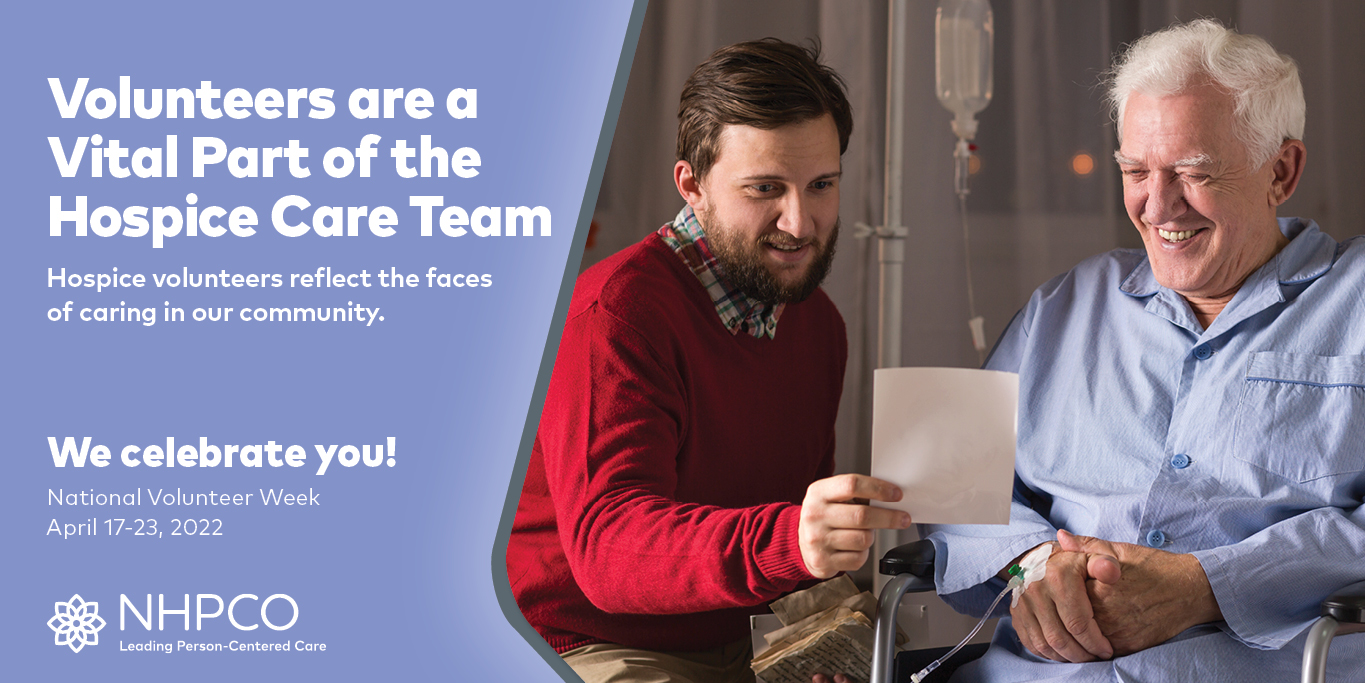
This week, the country celebrates National Volunteer Week. NHPCO and our member hospices nationwide send a heartfelt “thank you” to hospice volunteers. Without you, hospices could not deliver the quality of care that end-of-life patients deserve.  

 As part of our National Volunteer Week celebration, I want to share a few resources with you:  

  • The first is a video – “The Gift of Volunteering” – in which Mercedes Ibarra, a volunteer with Silverado Hospice in Irvine, CA, shares her experience as a hospice volunteer.
  •  The third is a list of five inspiring hospice volunteers who were recently honored as at the recipients of NHPCO’s 2022 Volunteers are the Foundation of Hospice Awards. Each honoree’s name links to a write-up about their service. 
In the first video above, hospice volunteer Mercedes Ibarra talks about her patients, saying: “I never knew I could love someone I didn’t know, that wholeheartedly.” That type of connection, that inspiration, that love – I saw that over and over as a hospice leader. That’s why I say that hospice volunteers are the embodiment of the theme of this year’s National Volunteer Week – “Volunteer Faces of Caring.” I hope you are as inspired by hospice volunteers as I am…not only this week, but all year round.  

P.S. If you are a hospice looking for communications resources to support your National Volunteer Week efforts, NHPCO is pleased to offer this NVW toolkit to our members. 


-###-

Ben Marcantonio, MS, MEd, LMFT, is the Chief Operating Officer at the National Hospice and Palliative Care Organization (NHPCO). He joined NHPCO in October 2020, bringing 30 years of leadership experience in educational, healthcare, and social service settings. Prior to joining the NHPCO senior leadership team, he was with Hospice of the Chesapeake where he served as President and Chief Executive Officer (2015-2020) and Chief Operating Officer (2013-2015). Prior to relocating to Maryland in 2013, he served as Chief Administrative Officer at San Diego Hospice and The Institute for Palliative Medicine.


Tuesday, April 12, 2022

National Healthcare Decisions Day: A Time to Think Ahead

By Edo Banach, NHPCO President & CEO 

In April, I’m always reminded of Benjamin Franklin’s famous quip that “Nothing is certain except death and taxes.” There’s a less famous, but in my opinion equally true corollary: “There are two things no one wants to think about: death and taxes.” 

NHPCO worked with our partners fifteen years ago to help found National Healthcare Decisions Day because we believe that people should be at the center of their health care decisions. NHDD continues to emphasize the importance that every person plays in the medical care they receive and to take action to make sure their wishes can be met even if they are unable to direct their own care. The only way to make sure that our priorities are understood and respected is to make sure that our care providers and loved ones know what our wishes are.

It's a heavy subject, to be sure, and like many important things in life, it’s worth taking steps that feel difficult at first. You will be glad you did, and so will the people who care about you the most. So, as we approach National Healthcare Decisions Day 2022, here are three steps you can take to make sure your can have a say in your health care, even if you cannot speak for yourself:

Learn about advance care planning, Advance Directives, and appointing a Healthcare Agent on CaringInfo.org and the National Institute on Aging. Even if you are very familiar with advance care planning and Advance Directives, it’s worth refreshing your memory, and making sure your plans still align to your values and wishes. Also, visit the Conversation Project for tips and tools to guide these important discussions with your care providers and those closest to you.

Choose a Healthcare Agent to make medical decisions for you, should you not be able to. Speak with that person about your values and wishes for your healthcare.

Ensure you have completed the Advance Directive form for your state or territory.

Hospice and palliative care providers always put patients at the center of the care plan. On National Healthcare Decisions Day, you have a reminder to put yourself at the center, so your loved ones will know how care for you if they ever need to step into that role. Your wishes matter, so make sure they are known.

-###-

Edo Banach, JD, is the President and CEO of the National Hospice and Palliative Care Organization. NHPCO is the leading organization representing integrated, person-centered healthcare, NHPCO gives ongoing inspiration, practical guidance, and legislative representation to hospice and palliative care providers so they can enrich experiences for patients and ease caregiving responsibilities and emotional stress for families. Visit www.nhpco.org


Wednesday, April 6, 2022

Grief Lessons Learned

By Arlene Stepputat, MA

“When grief is expressed and witnessed– listened to– without judgment, the physical and mental pain lessens and can re-awaken the human spirit.” 
~
Nathalie, end-of-life doula

Born out of the Covid-19 pandemic, and the desire to be of service in a time of death unlike anything seen before, the NHPCO End-of-Life Doula Council began a discussion of how we might be able to help.

Council members saw firsthand that hospices and other grief support options were overwhelmed. End-of-life doulas are trained to provide grief support–this felt like an ideal opportunity to develop a program of support for hospices and community members.

The premise was simple. Trained and seasoned end-of-life doulas volunteered to support people grieving due to loss during the pandemic, whether that was a Covid death or not. Free, confidential, one-on-one sessions via telephone or Zoom were offered to anyone in the US. Services were available in English or Spanish.

Thirteen months later, we have 10 volunteer doulas, the program has received more than 50 requests and each one has been answered. Once a month the doulas gather to share, make inquiries, and offer new resources.  

We asked our doulas to tell us what they experienced and what they are learning about grief. Here are some of the responses.

The depth of grief that I witnessed was palatable. Deep profound losses, the kind that change people’s lives, including my own. Bearing witness to their stories, to their experiences, and to their grief, allowed me to shed away any feeling of self-pity or martyrdom. One person described it as “being able to breathe better” after feeling heard. Personally, bearing witness has allowed me to truly slow down, become fully present, and become aware that life is truly precious. What a gift it is to be able to be with another while we journey together in this way, and so grateful for this grief program to guide the way. 
~Lynne- Anne

My grief support was basically to lend a listening ear, in a non-judgmental fashion; occasionally engaging in conversation when it was appropriate and welcomed. I have learned to become more comfortable with expressed anger, and not personalize what was shared. Some of the anger expressed was directed towards frustration with the medical profession and the providers who served their loved one who died. I usually waited until about the third session with my clients before I told them I am an RN with 17 years of Hospice experience. For some reason, that would usually help to lessen their anger and resentment.
~Dana

What is evident is that the pandemic so overloaded the medical system, that expectations for the kind of care one wanted for a loved one was rarely met given the sheer volume of those in need. Grief about not being able to be with people as they passed and the rules imposed to manage the spread of the disease showed up as anger at the system.

I had a client that had experienced a sudden and tragic loss. She had no one to speak with–not even her partner- as she felt it was a burden to talk about her loss. Speaking with me, she felt she was in a safe space, which was non-judgmental and comforting.
~Vicki

 I could assess that by the fourth session, there was a shift in their attitude about their grief process and finding some meaning in their losses. They all seemed to be trying to redefine their relationships with the loved one they had lost, and trying to live into a future without their beloved. All of them still had a desire to try and control their grief situation, even though they realize their losses are an uncontrollable situation. 
~Dana

The doulas provided a loving presence that allowed all expression. People could finally give voice to thoughts and feelings that were being kept inside.

For each of us, the awareness and expression of our grief can make us more authentic. Grief teaches us how to be present and centered, how to let go; it teaches us how to value life and death.

I have learned that grief is a universal yet extremely personal combination of emotions: raw, numbing, physical, visceral, that needs to be felt fully.
~ Nathalie

It has been said that particularly in our Western culture, we are grief ‘illiterate’. It is time that we all learned that holding another’s grief is beyond cards, Kleenex, and casseroles. We must learn the art of tending grief. We must start with our own and then as we continue our healing, we can better hold space for one another.

Here’s one final reflection:

I have learned that keeping an open mind is the best way forward.
I have learned that community is an essential ingredient in the grief recipe. 
I have learned that holding space for others and for myself (without trying to fix anything) is the most loving way to handle grief.
I have learned there are NO experts in grief: I am always a student.
I have learned that sharing one's grief is as important as bearing witness to one's grief.
I have found that grief needs to be listened to - more so than responded to.
I have learned that most often all that is needed is  a warm blanket and a hug.
I have learned that grief is a non-linear journey.

~Rai

 With the support of NHPCO, the COVID 19 Grief Project was launched in February of 2021 and continues today. Go to nhpco.org/doula-grief-support to learn more.


-###-

Arlene Stepputat, MA, is an end-of-life doula, a hospice chaplain and minister and a certified Advanced Care Planning Facilitator. She holds a Master’s Degree from Columbia University in Family and Community Education and a Master’s in Theology from Peace Theological Seminary. Arlene is a member of the NHPCO End-of-Life Doula Advisory Council. Her website is https://dyingingrace.com.


Wednesday, March 16, 2022

NHPCO Celebrates Hospice Providers Successfully Earning Quality Connections Rings in 2021

249 Hospice Organization Participated in Inaugural Year of Innovative Quality Improvement Program

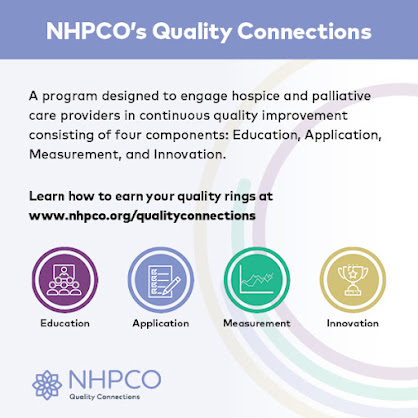
NHPCO is proud to share the names of member organizations that have earned rings in the inaugural year of its Quality Connections program. Launched by NHPCO in January of 2021, Quality Connections (QC) was designed to enhance the knowledge base, skills, and competency of hospice and palliative care professionals and providers for continuous quality improvement.

QC is structured around four fundamental pillars which are represented by four QC rings: Education, Application, Measurement, and Innovation.

“To simply say that a hospice organization is interested in quality is not enough. A hospice must demonstrate its commitment to patient- and family-centered care with measurable results and outcomes. One of the most effective ways to do this is through active participation in NHPCO’s Quality Connections,” said NHPCO President and CEO Edo Banach.  “As we share the results from the first year of Quality Connections, we are able to shine a light on hospice organizations that have made significant strides in improving their quality of care. This matters to patients, families, payers, and providers, and I congratulate the providers that participated.”

Of the hospice organizations that embarked on a continuous quality improvement journey last year, 116 programs earned rings reflecting their success in Quality Connections. Among those programs, 27 hospices have the distinction of achieving the top levels of earning three or four rings.

NHPCO salutes all the hospice programs that worked to demonstrate an organizational wide commitment to quality.  For the full list of hospices earning rings in 2021, see the full NHPCO press release (03/16/22).

Each Ring has specific activities incorporating practical resources to progressively track and improve both clinical and organizational quality. Activities such as quarterly data reporting and benchmarking, NHPCO’s E-Online courses, peer case studies, and engagement will be part of an organization’s quality journey. Additionally, participants will find activities that are focused on promoting diversity, access, and inclusion within an organization and with the communities they serve.

“For a hospice organization to be activity engaged with continuous quality improvement, commitment throughout the entire organization at all levels of staff is required,” said NHPCO Vice President of Quality Aparna Gupta. “And success should be celebrated at all levels within an organization with the reminder that the benefits are ultimately seen at the bedside of the person at the center of care.” 

QC is a benefit of NHPCO provider membership. For organizations that already have an established quality improvement program, Quality Connections can build on and streamline what they already have in place. If a provider needs to enrich their quality improvement efforts, Quality Connections will provide the guidance and resources they need.

It is not too late for NHPCO provider members to enroll in Quality Connections for 2022. Follow the steps in the Quality Connections User Guide to enroll in the program and to start your quality improvement journey.  

For their support of the Quality Connections program in 2021, NHPCO thanks its Gold Level Sponsors: Curitec and Optum Hospice Pharmacy Services, and Silver Level Sponsor ADVault, Inc.