Friday, May 7, 2021

Fulfilling My Lifelong Dream to Become a Nurse

In observance of Nurses Week, Care Dimensions RN Case Manager Nancy Drago reflects on her passion for nursing and how personal experience drew her to a professional career in hospice. 

As far back as I can remember, I have always wanted to be a nurse. As a child, I admired a close family friend who was a nurse who told me her work was rewarding because every day she had the opportunity to improve patients’ lives by providing quality health care. Recognizing my interest in nursing, she gave me one of her nursing text/workbooks the summer before I entered high school. Every day that summer I read this book and worked on the assignments as best I could independently. I was fascinated about the nursing field and could not wait to become a nurse.


Unfortunately, nursing school was not in my parents’ budget, so after graduating high school, I entered the workforce and later got married and had children. My plan was always to go back to nursing school once my children were older, and in 2014, I graduated from Lawrence Memorial/Regis College of Nursing. I could hardly wait to begin this new and exciting chapter in life that I had dreamed of since I was a child.

I began my nursing career at a small skilled nursing/rehab facility as a floor nurse and then as a charge nurse where I gained much experience caring for patients with various acuity levels, including hospice patients. It was then that I was introduced to and had the pleasure of working with several Care Dimensions team members who provided hospice care for some of our patients.

Learning how hospice helps

I saw how hospice brings comfort to patients and families when curative care is no longer possible. My professional experiences with Care Dimensions led me to hold the highest respect for hospice nursing because of the significant value and quality of life it provides to patients and their families facing end of life. A very personal experience led me to realize that hospice nursing was my true passion.

In March 2018, my husband was diagnosed with a very aggressive form of ALS, which took his life just five months later at the age of 60. I cared for him at home but as his disease progressed, his neurologist recommended hospice. Given my prior professional experience with Care Dimensions, there was no question that this was the only organization I would consider for my husband’s end-of-life care.

I remember the hospice nurse assigned to my husband and how extremely thorough, compassionate, supportive and intuitive she was in determining what would be most helpful for him in the days ahead – services such as massage therapy for his tight and rigid muscles and music therapy, which he enjoyed so very much. Care Dimensions offered my family pre-bereavement support and planning, guidance, and valuable resources during his care, which continued even after his passing. Thanks to the hospice team, my family never felt alone and I did not have to be his nurse 24/7. I could be his wife again knowing that our team of wonderful caregivers were always just a phone call away.

As difficult as my husband’s end-of-life journey was, I will always be grateful for the personal experience I had with Care Dimensions because it made me realize my passion for hospice nursing. It also helped me understand what truly is important to patients and families at end of life, as well as their fears and emotions.

The rewards of hospice nursing

Hospice nursing is one of the most rewarding nursing careers because of its very nature. I consider it an honor to be invited into a patient’s home and explore options to improve their quality of life with support from my interdisciplinary team. Patients and families are often overwhelmed, frightened and inexperienced, but as their nurse, I teach, guide, prepare and empower family members to partner in the care of their loved one at end of life. I am also an advocate who ensures that all members of the health care team are available. It is my priority to ensure that families have all the resources and tools they need to honor their loved one’s goals and wishes for end-of-life care.

It is very rewarding as a nurse to walk with patients and families through their most difficult days and help guide them to a peaceful, comfortable passing. The trust that is established between patient and nurse allows the patient and family to be comfortable sharing their true feelings and being honest about their goals, wishes and fears so that they can be addressed. This important message provided me with peace when I was facing the difficult days of my husband’s end-of- life journey.

I have been working for Care Dimensions for approximately nine months and am thankful and proud to represent this outstanding hospice organization. I have found my niche and am so grateful every day for a new opportunity to make a meaningful difference for my patients and families at such a difficult time in their lives.

One of the most important lessons I have learned as a hospice nurse is that just as every person’s experience with life is different, so is their end-of-life journey. It is important to learn as much as possible about each patient, their family, experiences, special memories, and hobbies/interests, all of which help to understand the patient and what is important to them and their family. This intimate knowledge helps the hospice team develop the best individualized care plan that closely meets the patient’s needs and goals as they journey through end of life.

A favorite memory I have was with a hospice patient who was an accomplished jazz pianist but was no longer able to play his piano because he couldn’t climb the stairs to get to it on the second floor of his home. He would reminisce about playing at various functions and for his family, and how much he missed that because it brought him so much joy.

I asked his family if it was possible to have the piano moved downstairs so that he could play again. I’ll never forget the day I walked into his home for my weekly visit and there he was sitting at his piano just waiting for me to enter and when I did, he began to play a song that he had written just for me. While he played, I could see the joy in his eyes and the smile on his face. He had forgotten about his shortness of breath, inability to walk and the pain that was keeping him from living the life he once lived. This experience brought tears to my eyes. There is no greater gift or reward as a hospice nurse than knowing that you have succeeded at delivering the very best individualized and quality nursing care possible and bringing peace and contentment to a patient at end of life.

Tuesday, May 4, 2021

Her Last Rodeo

By Erin Collins, BSN RN CHPN

We got the call midweek from a woman who was looking for assistance in supporting her dear friend who was living with chronic illness. She had been visiting this friend for several weeks, listening and helping with small tasks around the house, and going for walks when they felt up to it. Her friend, it seemed, was getting worse now—she knew this dear woman needed more than she could give and had heard about our end-of-life doula service. 

I made an initial visit to assess what was needed for this 52-year-old woman (HL) living with Familial Pulmonary Fibrosis, Bronchial Adenocarcinoma, Emphysema and Interstitial Lung Disease (all hereditary) as well as Rheumatoid Arthritis. She was on a trial with OFEV, but the fibrosis was unresponsive to treatment. I learned that she lived with her 3rd husband, her high-school sweetheart. He worked 60-hour weeks in construction- leaving HL at home alone for 12 hours a day. She required high-flow oxygen and due to wildfires in our area, was unable to leave the house. Newly acquired pneumonia had her coughing almost incessantly and unable to sleep at night unless she sat completely upright, even with her 4th course of levaquin. HL was under the palliative care service of the local health system for pain management and was also seeing her pulmonologist—both of these were telehealth visits due to COVID-19. Although it was apparent to me with my hospice nursing background that she would meet criteria, HL made it quite clear that she wasn’t ready to die, didn’t want to talk about hospice and wasn’t ready to go there. Isolated, lonely, and quite ill, what HL needed most was additional support and companionship. An end-of-life doula was a perfect resource.

We began visiting her home atop a long mesa overlooking a beautiful canyon in the high desert, 45 minutes from the largest town, where our doulas all reside. We agreed to weekly 2-3 hour visits, taking the appropriate precautions with masking and distance in the house. We rotated weekly, so HL met each of the 5 doulas on our team, and each brought a unique specialty to the visit. Regardless of the specialty, what we quickly learned was that what she needed most was a listening ear. We had plans and ideas on how to help her get through tasks she wanted to complete—sorting out photos, being creative again, labeling family antiques for her sons. Each week, however, HL quickly began sharing whatever she needed to share—retelling old traumas, venting about friendships, describing her symptoms and frustrations with acquiring needed medications, and entrusting us with the story of her estranged relationship with her oldest son. We listened, and each time that we heard something that fell under the provision of hospice, we gently reminded HL, “I know you aren’t ready, but when you are—this is something hospice can provide.”

During our third visit, HL told me that she was ready to consider hospice, “because you all made it sound not so scary, not such a death sentence.” She wanted to wait to finish one more Rituxan infusion for her RA, but then she would be ready to enroll. Three weeks later, one week shy of that last infusion, pneumonia had worsened in her lungs and her palliative care provider finally made the recommendation that she enroll in hospice immediately. She called me in a bit of a panic, and at the same time knowing she was ready for this step. I offered reassurance and support and planned to be present for her admission visit at home.

Throughout our 6 weeks with HL, her husband was not on the same page. I met him for the first time at her hospice admission visit, where he told me that if she were to stop breathing, he would do “everything I could to save her life.” This arose during a discussion of her advance directive, which I knew she had not yet completed. However, from the relationship we had developed, I knew that she no longer wanted to be resuscitated. I gently encouraged them to complete the form to honor HL’s wishes. Her husband was not ready for this step.

HL was on hospice care for 8 days. Seven of those days were in the inpatient unit, where she was given around the clock care and a more appropriate level of symptom management than she had at home. I had the great honor to be able to visit with her in the inpatient unit, where she expressed her gratitude for our relationship. HL knew that if we had not become involved in her care, she would have ended up back in the ICU and would have died there. We were able to talk about hospice in a way that didn’t mean death to her, even though the hospice admission is exactly what allowed her to become comfortable and relaxed and to die in a more peaceful manner. Her trust in our doulas evolved into her husband’s trust of our doulas which in turn allowed him to trust hospice and to trust the process of her natural death.

The most profound experience for HL occurred during my visit to her at the hospice house-- her estranged son called on the phone. HL was beside herself, knowing that the out-of-state number was him. I offered to step out of the room, but she insisted I stay and hold her hand throughout the conversation. After they hung up, she felt as if a miracle of healing had just happened for her, and that part of the miracle was having her doula in the room at the exact time of the call. We had been there to hear the story every week for the 6 weeks prior to her hospice admission. Although this healing could have happened with the support of hospice, it wouldn’t have happened during her short length of stay.

HL was a championship barrel racer and rodeo belt buckle designer. A week before her death, her last buckle design arrived: for her husband. He wore it to the hospice house and we let her know he wouldn’t take it off while he was there. The night of her death, I dreamt of her racing around barrels in the clouds. She certainly rounded barrels in her last year of life; it was our honor to bridge the gap between the barrel race and hospice care.

-###-

Erin Collins, BSN RN CHPN is a NEDA-proficient End-of-Life Doula, member of the NHPCO End-of-life DoulaCouncil and the co-director of The Peaceful Presence Project in Bend, OR.

Monday, May 3, 2021

Optum Continues Support of NHPCO as a Strategic Partner

Optum is a Diamond Level Strategic Partner and Gold Level Sponsor of Quality Connections

The National Hospice and Palliative Care Organization (NHPCO) proudly recognizes Optum Hospice Pharmacy Services (Optum) as a Diamond Level Strategic Partner. Through this generous commitment, Optum will play a valuable role in support of NHPCO’s efforts to lead person- and family-centered care in the U.S.  

Optum further demonstrates its commitment to high-quality hospice care as a Gold Level Sponsor of NHPCO’s Quality Connections program. Quality Connections was developed and launched in January 2021 to enhance the knowledge base, skills, and competency of hospice and palliative care staff through education, tools, resources, and opportunities for engagement and interaction among hospice and palliative care professionals.

Optum has been a long-time supporter of NHPCO’s professional development activities, most notably as the sole sponsor of the 2020 summer Virtual Conference that focused on quality. This virtual conference was seen in all 50 states last July.

“Through its generous support, Optum continues to work with NHPCO on efforts to raise the bar for hospice and palliative care providers and professionals with a focus on innovation, access, and quality,” said NHPCO President and CEO Edo Banach. “Ultimately, support of our mission and the membership is all about ensuring the highest standard of care for patients and families, and excellence among the provider community.”

“We're excited to expand our role in supporting NHPCO and its ongoing commitment to the hospice and palliative care community,” said Jason Kimbrel, PharmD, BCPS – Vice President, Optum Hospice Pharmacy Services. “The importance of the Quality Connections program aligns with Optum's initiatives to support organizations that showcase high-quality, person centered care which leads to overall service excellence within the industry.”

For over 25 years Optum Hospice Pharmacy Services has been empowering hospice care through a flexible, forward-thinking approach by providing industry leading expertise in helping providers control costs, improve technology, and deliver exceptional service so they can put their energy where it matters most — with their patients.


-###-

Wednesday, April 28, 2021

NHPCO Surveys Membership on Medical Group Practice

In April 2021, NHPCO conducted a survey of its membership to learn more about the use of medical group practices among these hospice providers and interest in developing such a service. Hospice organizations already invest in medical providers, including physicians and nurse practitioners, as members of their interdisciplinary team, so there could be opportunity for hospices to build out a medical group practice.

Health care organizations that have a medical group practice are at an advantage when it comes to participating in new care models. Creating a medical group practice is also the fastest way to build a palliative care program and secure reimbursement through Medicare B billing.  

Nearly 20 percent of NHPCO’s provider members responded. This reflects the feedback of 230 hospices from among the organization’s 1,200 provider members.

Among the survey findings:

·         27 percent of respondents reported that they have a medical practice group as part of their services.

·         26 percent of respondents indicated an interest in developing this service. 

·         Approximately 50 percent of the members with an existing medical group reside within a geographic location that is eligible to participate in the Primary Care First model. 

·         66 percent of respondents provide palliative care services; however, currently only 9 percent offer primary care services.

·         38 percent of respondents provide certified home health care.

·         25 percent provide other services such as assisted living, long term care, private duty care, home infusion, PACE, and pediatric concurrent care. 

An overwhelming majority of respondents are interested in participating in focus groups to assist NHPCO in building out resources to help others build and sustain medical practice groups.

“One of the things we are helping hospice providers understand is the range of opportunities that exist among the various models being offered or developed by the Center for Medicare and Medicaid Innovation,” said NHPCO Vice President for Palliative and Advanced Care Lori Bishop. “The skills of the Interdisciplinary Team and the expertise that hospice professionals have in care management can be of great value to organizations that are part of Direct Contracting or Primary Care First models.”

NHPCO members will find additional information on some of these models on the Models and Demos page of the NHPCO website.

Monday, April 19, 2021

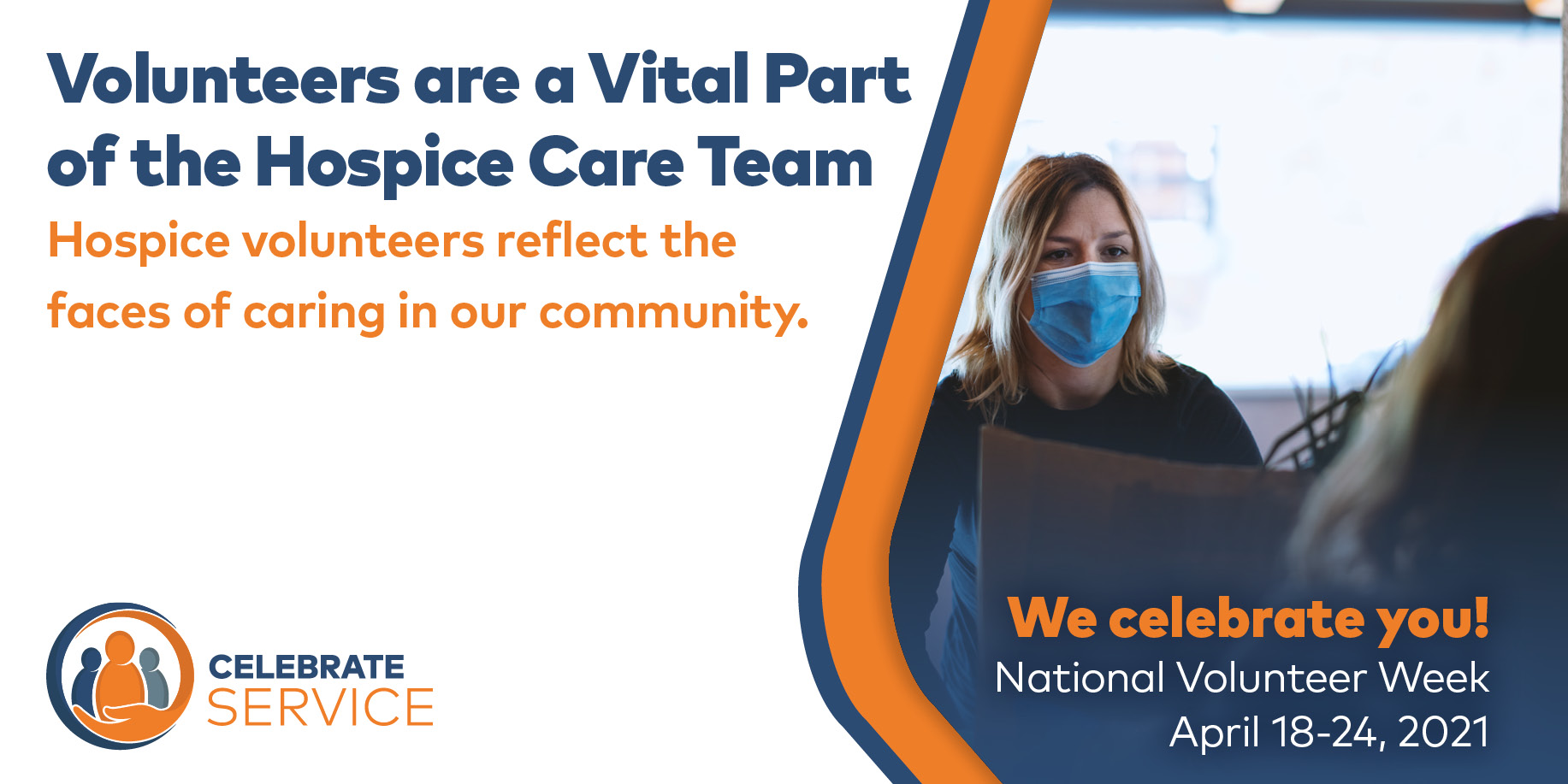
NHPCO Issues Proclamation Honoring Hospice Volunteers During National Volunteer Week, April 18 – 24, 2021

Volunteers are the Heart of Hospice

In recognition of National Volunteer Week, the National Hospice and Palliative Care Organization (NHPCO) has issued the following proclamation to celebrate the contributions and gifts of America’s dedicated hospice volunteers. And even during this past year, when the pandemic altered so many practices, hospice volunteers remained active making masks and gift baskets, helping with outreach and fundraisers, and doing what they could within safety guidelines to let patients and families know that they were being thought of and cared for.


“Hospice volunteers play an indispensable role in enabling hospice and palliative care organizations to offer the highest-quality care and support possible for the people they serve. By sharing their time, energy, and expertise, volunteers bring compassion and caring to the lives of those in need,” said NHPCO President and CEO Edo Banach.

NHPCO National Volunteer Week Proclamation

Whereas, volunteering is an important activity for millions of Americans throughout the U.S., the compassionate individuals who serve as trained hospice volunteers deserve special recognition during this week of celebration and awareness;

Whereas, these dedicated hospice volunteers give of their time and talent in support of patients and families who are our relatives, friends, and neighbors;

Whereas, these volunteers are essential members of hospice and palliative care teams that care for an estimated 1.55 million hospice patients every year and ensure that they live with hope, dignity, and love despite serious and life-limiting illness;

Whereas, hospice volunteers contribute in creative ways to support health care workers as well as patients and families during this time of a global pandemic;  

Whereas, National Volunteer Week provides the opportunity to recognize the contributions of these caring hospice volunteers and raise awareness of the benefits of hospice and palliative care;

Now, therefore, be it resolved that the NHPCO board of directors do hereby proclaim April 18 – 24, 2021 as National Volunteer Week across the U.S. and encourage the support and participation of all citizens in learning more about and participating in the provision of hospice and palliative care to those in our community.

National Hospice and Palliative Care Organization
Board of Directors
April 19, 2021

# # #

NHPCO Volunteer Awards

NHPCO presented the 2020 Volunteers are the Foundation of Hospice Awards during its Virtual Interdisciplinary Conference, October 2020. Watch a video of the awards presentation honoring the 2020 volunteer honorees.

NHPCO members are encouraged to submit a nomination for a star volunteer for the 2021 awards that will be presented during the Interdisciplinary Conference scheduled for September 20 – 22, 2021. Deadline for submitting nominations is April 30. NHPCO members will find more information online.

Learn more about volunteering for a hospice in your community by reaching out to a local hospice provider. NHPCO’s Find a Provider online tool will help you find a provider in your area.

Friday, March 19, 2021

Hospice Social Work: A Calling that Satisfies


Even during a public health emergency, hospice and palliative care professionals rise to the challenge of providing compassionate, person-centered care in the community. In observance of Social Work Month, two Care Dimensions social workers, Jennifer Sheng and Jackie Butler, discuss what attracted them to their profession, lessons learned, and what they’ve found fulfilling about hospice social work – even amidst the pandemic.


Why did you become a hospice social worker?

Jennifer Sheng - Ever since I was young, I wanted to be a therapist. I had an initial interest in
Social Worker Jennifer Sheng meets with a patient
(photo taken before COVID-19 pandemic)
psychology, but I was drawn to social work for its holistic approach to care. This became clear to me when working in a residential psychiatry unit where the focus was on treating people as people, instead of seeing them as “ill” or “sick.”

Growing up, I spent a lot of time with my grandparents and as a result, I was raised with a deep respect and appreciation for my elders. Not only did they teach me how to bowl and play bridge, but I enjoyed hearing about their greatest triumphs, deepest sorrows, and especially how those experiences culminated into the amazing people I loved. I saw that getting older was something to be cherished.

Once I decided to pursue my master’s degree in social work, I knew I wanted a career that combined physical and mental well-being. My school offered a dual certificate program in gerontology and behavioral medicine, and hospice was a natural fit.

Jackie Butler - I’ve always loved talking and connecting with people, learning about who they are and hearing their stories. This curiosity made social work a great fit for me. I’ve also found issues of death and dying interesting. I’ve wondered how psych-social and spiritual factors can have such an important impact on someone’s end-of-life journey. Being a caretaker for my mother who suffered with a very slow progressing form of ALS solidified my desire to help patients and families navigate the challenges of living with life-limiting illness.


What are some lessons you’ve learned as a hospice social worker?

Jennifer - I’ve learned that there is no “correct” end-of-life experience. I’ve been with hundreds of patients and their families through that journey, and each of them have been as unique as the individuals themselves. Some patients want to be at home surrounded by family, others feel comforted by the sounds of a hospital setting, and everything in between. It’s our job to listen to their values and needs and help guide them toward a desired outcome.

Jackie - Under the best of circumstances, dealing with life-limiting illness in whatever phase a patient and family are moving through can be emotionally daunting and filled with difficulty. Navigating this end-of-life journey during the COVID-19 pandemic has brought increased isolation and loneliness. In a time when they need to access extra support, their ability to connect and feel supported is limited. Many of our families have not been able to visit with a patient who was in a long-term care facility or hospital. The past year has brought a different kind of grief as families learn new ways of celebrating the life of a loved one, when traditional customs designed to help bring comfort and support are no longer possible. As social workers, we help by naming the frustration and concerns while compassionately listening and supporting. We offer normalization, validation and reassurance to our patients and families. We can’t take away their pain, but we can support them and hold this space while they process difficult and intense feelings.


What do you find fulfilling about hospice social work?

Jennifer - Easily, it is the time I spend with my patients and their loved ones. I’m so humbled when a family lets me into their home at such a vulnerable time, especially during the COVID-19 pandemic. That takes a large amount of trust, and I strive to give that the respect it deserves. I especially enjoy getting to know each of my clients and what they hope for. Together, with the whole care team, we can usually bring that hope to reality. Death will happen to 100% of us – we don’t get a choice in that. What we do get a choice in is how we spend those last months, weeks, and days. There’s a lot of hope in that. There’s a lot of love in that. I feel so honored to help my patients understand this and have the life they want.

Jackie - One of the best aspects of this job is working with an amazing interdisciplinary team. Having multiple disciplines all working together and each bringing their unique perspective enhances our understanding of patients and families. Essentially, we all help them define their goals to determine what’s needed or important for them to make the most of whatever time they have left. The focus really becomes about living with the best quality of life, which I find so fulfilling.


What’s one of your favorite memories with a patient?

Jennifer - Recently, I had a patient who hoped to go to Encore, the new Boston-area casino, but the risk of contracting COVID-19 was too high. Instead of taking him to the casino, we brought the casino to him! His hospice nurse and I brought appetizers, decorations, cards, chips, and a craps table. Only problem was that we had overlooked the minor detail that neither she nor I knew how to play craps! I watched hours of YouTube tutorials before calling for mercy, but we forged ahead anyway. We surprised John with the event, and he surprised us by teaching us all how to play craps. He was able to win big that night and redeem his chips for a prize we arranged for him. I’ll always remember the big smile on his face as he taught us how to play the game, and the gentle way he and his family cheered each other on. It was really such a privilege to be a part of that. As corny as it sounds, that’s the part of my job I love the most – making dreams come true.

Jackie - We had a patient come into the Care Dimensions Hospice House transitioning to end of life. I’ll call her Anna. She was developmentally disabled, minimally responsive, and unable to make her needs known. Anna had a case worker through the Department of Developmental Services and an adult daycare manager who were very fond of her, but unable to visit due their own agencies’ COVID-19 limitations. In speaking with these caregivers over the phone, I learned Anna loved to dance and listen to “Island Music.” At work, when she heard this music she would laugh, sing, and dance. I was told her smile was infectious when the music came on. I sat bedside, held her hand and played music from her favorite band. When I drove home that night, I had a smile on my face. Such a small detail, but one that I felt such satisfaction in believing it brought Anna comfort in her last days.

If you would like to share the creative ways your hospice and palliative care team is caring for patients amid the COVID-19 public health emergency, please send us your photos and stories so you can be featured in the #hapcFacesOfCaring campaign.  

Wednesday, March 3, 2021

Honoring Patient Choice and Organ Donation


By Natalie McNeal, Wellstar Community Hospice, and
Kim Kottemann, LifeLink Foundation

Honoring patient choices means that we must offer options to our patients and look beyond our current service offerings while operating within legal, compliance, and regulatory boundaries.  More than ever, medical providers are focusing on patient preferences and needs, and hospice can be a solution.  Goals of care do not have to be mutually exclusive because they have not been paired with hospice services in the past.  Instead, we must consider how hospice can complement the continuum of care.  
 
In 2016, our team was asked a simple question, “Why can’t we use hospice with patients who want to donate vital organs?”  This led our team on a patient experience journey and an otherwise unlikely partnership with our state’s organ procurement organization.  Until hospice providers begin to seek understanding of service lines we thought were mutually exclusive to hospice, we will not be able to provide an exhaustive array of options for those who can truly benefit from hospice services. Good goals of care should include all end-of-life options for patients and families.   
 
In a report from the National Academies of Sciences, Engineering, Medicine, researchers write, "In recent years, many initiatives to increase the rates of organ donation have been undertaken. Several of these efforts are early in their implementation phases and have not yet been fully evaluated. Although organ donation rates have risen in the past 5 years, it is difficult, if not impossible, to determine exactly how much each initiative or regulatory change has contributed to that rise. Taken together, the data suggest that a multipronged approach is necessary to realize the potential of organ donation in the United States."*
 
For those who are participating in NHPCO's 2021 Leadership and Advocacy Conference, we invite you to join us for our presentation on Concurrent Use of Hospice and Organ Donation in Acute Care to learn how we vetted this expansion of our service and applied an ethical framework to guide our decision to include organ procurement as a choice for a subset of our patients.  Honoring a patient’s wish to pursue the gift of life after their death has inspired our team to effectively utilize our expertise for a population we did not previously serve.
 

*"4 Systems To Support Organ Donation." Institute of Medicine. 2006. Organ Donation: Opportunities for Action. Washington, DC: The National Academies Press. doi: 10.17226/11643.