exactly as you want them
to treat your best customers.”
–Stephen Covey
-###-
Edo Banach, JD, is the President and CEO of the National Hospice and Palliative Care Organization. NHPCO is the leading organization representing integrated, person-centered healthcare, NHPCO gives ongoing inspiration, practical guidance, and legislative representation to hospice and palliative care providers so they can enrich experiences for patients and ease caregiving responsibilities and emotional stress for families. Visit www.nhpco.org.
By Arlene Stepputat, MA
“When grief is expressed and witnessed– listened to– without judgment,
the physical and mental pain lessens and can re-awaken the human spirit.”
~Nathalie, end-of-life doula
Born out of the Covid-19 pandemic, and the desire to be of
service in a time of death unlike anything seen before, the NHPCO
End-of-Life Doula Council began a discussion of how we might be able to
help.
Council members saw firsthand that hospices and other grief support options were overwhelmed. End-of-life doulas are trained to provide grief support–this felt like an ideal opportunity to develop a program of support for hospices and community members.
The premise was simple. Trained and seasoned end-of-life doulas volunteered to support people grieving due to loss during the pandemic, whether that was a Covid death or not. Free, confidential, one-on-one sessions via telephone or Zoom were offered to anyone in the US. Services were available in English or Spanish.
Thirteen months later, we have 10 volunteer doulas, the program has received more than 50 requests and each one has been answered. Once a month the doulas gather to share, make inquiries, and offer new resources.
We asked our doulas to tell us what they experienced and what they are learning about grief. Here are some of the responses.
The depth of grief that I witnessed
was palatable. Deep profound losses, the kind that change people’s lives,
including my own. Bearing witness to their stories, to their experiences, and
to their grief, allowed me to shed away any feeling of self-pity or martyrdom.
One person described it as “being able to breathe better” after feeling heard.
Personally, bearing witness has allowed me to truly slow down, become fully
present, and become aware that life is truly precious. What a gift it is to be
able to be with another while we journey together in this way, and so grateful
for this grief program to guide the way.
~Lynne- Anne
My grief support was basically to lend a listening ear, in a
non-judgmental fashion; occasionally engaging in conversation when it was
appropriate and welcomed. I have learned to become more comfortable with
expressed anger, and not personalize what was shared. Some of the anger
expressed was directed towards frustration with the medical profession and the
providers who served their loved one who died. I usually waited until about the
third session with my clients before I told them I am an RN with 17 years of
Hospice experience. For some reason, that would usually help to lessen their
anger and resentment.
~Dana
What is evident is that the pandemic so overloaded the medical system, that expectations for the kind of care one wanted for a loved one was rarely met given the sheer volume of those in need. Grief about not being able to be with people as they passed and the rules imposed to manage the spread of the disease showed up as anger at the system.
I had a client that had experienced a sudden and tragic loss. She had
no one to speak with–not even her partner- as she felt it was a burden to talk
about her loss. Speaking with me, she felt she was in a safe space, which was
non-judgmental and comforting.
~Vicki
I could assess that by the
fourth session, there was a shift in their attitude about their grief process
and finding some meaning in their losses. They all seemed to be trying to
redefine their relationships with the loved one they had lost, and trying to
live into a future without their beloved. All of them still had a desire to try
and control their grief situation, even though they realize their losses are an
uncontrollable situation.
~Dana
The doulas provided a loving presence that allowed all expression. People could finally give voice to thoughts and feelings that were being kept inside.
For each of us, the awareness and expression of our grief can make us
more authentic. Grief teaches us how to be present and centered, how to let go;
it teaches us how to value life and death.
I have learned that grief is a universal yet extremely personal
combination of emotions: raw, numbing, physical, visceral, that needs to be
felt fully.
~ Nathalie
It has been said that particularly in our Western culture, we are grief ‘illiterate’. It is time that we all learned that holding another’s grief is beyond cards, Kleenex, and casseroles. We must learn the art of tending grief. We must start with our own and then as we continue our healing, we can better hold space for one another.
Here’s one final
reflection:
I have learned that keeping an open mind is the best way forward.
I have learned that community is an essential ingredient in the grief
recipe.
I have learned that holding space for others and for myself (without
trying to fix anything) is the most loving way to handle grief.
I have learned there are NO experts in grief: I am always a student.
I have learned that sharing one's grief is as important as bearing
witness to one's grief.
I have found that
grief needs to be listened to - more so than responded to.
I have learned that most often all that is needed is a warm blanket and a hug.
I have learned that grief is a non-linear journey.
~Rai
Arlene Stepputat, MA, is an end-of-life doula, a hospice chaplain and minister and a certified Advanced Care Planning Facilitator. She holds a Master’s Degree from Columbia University in Family and Community Education and a Master’s in Theology from Peace Theological Seminary. Arlene is a member of the NHPCO End-of-Life Doula Advisory Council. Her website is https://dyingingrace.com.
249 Hospice Organization Participated
in Inaugural Year of Innovative Quality Improvement Program
NHPCO is proud to share the names
of member organizations that have earned rings in the inaugural year of its Quality Connections program.
Launched by NHPCO in January of 2021, Quality Connections (QC) was designed to
enhance the knowledge base, skills, and competency of hospice and palliative
care professionals and providers for continuous quality improvement.
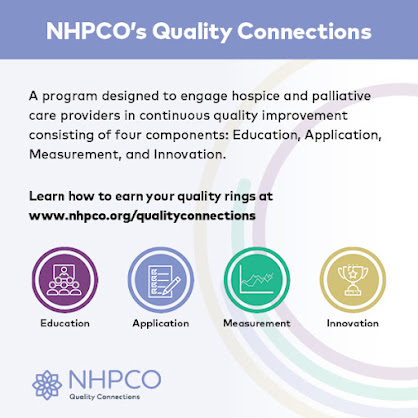
QC is structured around four fundamental pillars which are
represented by four QC rings: Education,
Application, Measurement, and Innovation.
“To simply say that a hospice organization is interested in
quality is not enough. A hospice must demonstrate its commitment to patient-
and family-centered care with measurable results and outcomes. One of the most
effective ways to do this is through active participation in NHPCO’s Quality
Connections,” said NHPCO President and CEO Edo Banach. “As we share the results from the first year
of Quality Connections, we are able to shine a light on hospice organizations
that have made significant strides in improving their quality of
care. This matters to patients, families, payers, and providers, and I
congratulate the providers that participated.”
Of the hospice organizations that embarked on a continuous
quality improvement journey last year, 116 programs earned rings reflecting
their success in Quality Connections. Among those programs, 27 hospices have
the distinction of achieving the top levels of earning three or four rings.
NHPCO salutes all the hospice programs that worked to demonstrate an organizational wide commitment to quality. For the full list of hospices earning rings in 2021, see the full NHPCO press release (03/16/22).
Each Ring has specific activities incorporating practical
resources to progressively track and improve both clinical and organizational
quality. Activities such as quarterly data reporting and benchmarking, NHPCO’s
E-Online courses, peer case studies, and engagement will be part of an
organization’s quality journey. Additionally, participants will find activities
that are focused on promoting diversity, access, and inclusion within an
organization and with the communities they serve.
“For a hospice organization to be activity engaged with continuous quality
improvement, commitment throughout the entire organization at all levels of
staff is required,” said NHPCO Vice President of Quality Aparna Gupta. “And
success should be celebrated at all levels within an organization with the
reminder that the benefits are ultimately seen at the bedside of the person at
the center of care.”
QC is a benefit of NHPCO provider membership. For organizations that already
have an established quality improvement program, Quality Connections can build
on and streamline what they already have in place. If a provider needs to
enrich their quality improvement efforts, Quality Connections will provide the
guidance and resources they need.
It is not too late for NHPCO provider members to enroll in Quality
Connections for 2022. Follow the steps in the Quality
Connections User Guide to enroll
in the program and to start your quality improvement journey.
For their support of the Quality Connections program
in 2021, NHPCO thanks its Gold Level Sponsors: Curitec and Optum
Hospice Pharmacy Services, and Silver Level Sponsor ADVault, Inc.
By Jessica Curd, LCSW
Children are not supposed to die. It flies in the face of
expectations we have of the natural order.
And yet, it happens. Sometimes the death is sudden and sometimes it is
from life limiting illness. As a hospice social worker, I had the honor of supporting
dying children and their families. Losing a child can be particularly complex –
in anticipating death, there is still a hope and wish for children to improve
and endure. There are other avenues of hope in death, however, and it was a
dying child and her supportive doula that helped me see aspects of hope even in
the face of death.
Children, even when dying, are brave, vulnerable, and full
of life, humor, and love. They are raw and real and openly share their thoughts
and feelings, and are often more prepared for their death than their parents,
helping to support and prepare family and friends.
One family I remember well had three adopted children, two
of whom had terminal illnesses. They had fostered these little ones and endured
the arduous process of adoption, combined with learning all the aspects of care
their children would need, often through long hours of the night. One decision
they made early on was to reach out to an end-of-life doula, who they heard
about at their church just weeks prior to one of their children being referred
to hospice. This decision ended up making all the difference for them.
Sam’s family reached out to doula Trish through a church
connection, and were pleasantly surprised to learn that Trish was a volunteer
with the hospice that would be serving their dying daughter Samantha. Trish was
new to the hospice organization, but she was an experienced volunteer. She was
in her twenties, studying to be a social worker, and had a vibrant and playful
personality. She was a perfect match for Sam, age 6, who had a contagious laugh
and a heart full of love.
One of the greatest benefits of having Trish as a doula was
that she could spend a lot of one-on-one time with her. In my role as a hospice
social worker, I often had a caseload of 35-60 patients at any given time,
wishing I could be in four places at once and knowing I needed to triage. It
brought great comfort to know that Trish was visiting Sam every day–playing
peek-a-boo, coloring, singing and sitting with her as she watched Barney on TV.
Trish kept me informed on Sam and her family. One day, while
watching Barney, Sam pointed to clouds and then gestured “sleep”. Trish
realized that perhaps Sam had some awareness of spirituality or death and
called our chaplain. He and I made a visit along with Trish, as she had
developed the skills to communicate with Sam. It was at that visit when Sam
pointed to “goodbye” and “Barney.” When asked if she was talking about heaven
and sleeping, Sam became quiet and looked to Trish. She had a trust and
familiarity with Trish that allowed Trish to read right away that Sam was
needing help finding the words. Trish used the communication board and provided
soothing encouragement. Sam then said “yes, I bye.” Even at her age, she seemed
to know. We were amazed. We also asked if she wanted Barney with her for Heaven
and she giggled and looked at Trish. Trish asked her again and pointed to some
pictures as well. Sam pointed to Barney and smiled and Trish agreed that Sam
wanted Barney with her when she died, and maybe playing on the TV. We used this
conversation together to relay end-of-life wishes to the family and continued
to work with them to plan for Sam’s death. Trish and Sam’s parents made a
scrapbook and some memorial items such as hand and foot molds. They created a
playlist of Sam’s favorite music to soothe her and to use for her memorial.
Sam slept often and progressed toward death. Though the team
came together and surrounded the family with support, Trish’s presence was
invaluable. She increased her hours, stayed with Sam so her parents could get a
break, and continued to ensure Sam received comfort measures and helped the
family track this. She supported Sam’s siblings by singing to all the kids
together and playing guitar for them.
At the time of Sam’s
passing, Trish was right there at her bedside, along with her parents, while
Barney’s “I love you” song played and they held hands in reverence for this
sweet and innocent life. It was a powerful and beautiful moment. Inside the
pain and trauma and imperfections of life, Sam died peacefully and just as she
wanted. The chaplain and I arrived at Sam’s bedside to provide comfort and
prayer. Trish and I called the funeral home and helped prepare them for next
steps. They wrapped Sam in her favorite blanket, tucking Barney under one of
her arms, close to her heart, for her journey to the funeral home.
Sam brought us hope and bravery in the face of heartache and
tragedy. In the same way, Trish entered this family’s life when they needed her
the most, with an invaluable contribution of support and friendship. Trish and
Sam’s relationship impacted the hospice team, reminding us of the value of the
deep and meaningful care end-of-life doulas provide.
-###-
Jessica Curd, LCSW is a Certified Hospice and Palliative
Care Social Worker (APHSW-C), at Our Hospice in Indiana. She is a visiting
professor at Indiana University and is pursuing a PhD in Social Work there as
well. She is an active member of the NHPCO End of Life Doula Advisory Council and is passionate about supporting and advancing the role of end-of-life doulas
in Hospice and Palliative Care. Jessica lives with her family of 4 in
Greensburg, Indiana.